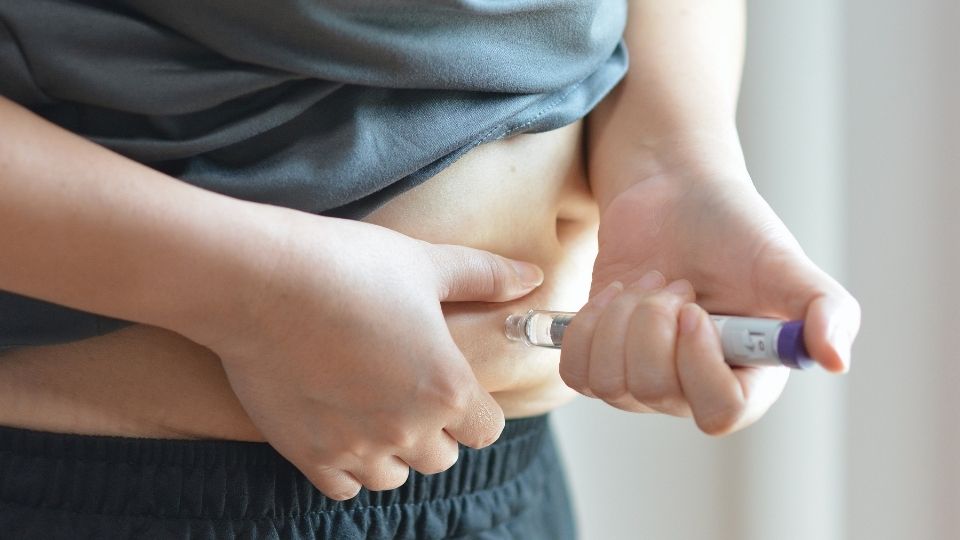
Both medications go into the fatty tissue just under the skin in one of three approved sites: the abdomen, the thigh, or the back of the upper arm. Rotate to a different spot every week.
That is the short answer. The longer answer covers which of the recommended injection sites for GLP-1 medications tends to be easiest to reach on your own, why rotation matters more than site choice, and what a normal injection site reaction looks like versus one worth a phone call.
One rule sits above everything below. Your device comes with an Instructions for Use, and that document governs. This article does not cover dose, dose setting, or how to prepare a dose, because those belong with your prescriber and your Instructions for Use. If you are starting treatment, Azona Health provides medical weight loss with provider guidance through the first injection and beyond.
The Three Approved Sites

Both drugs are given as a subcutaneous injection, meaning into the fat layer just under the skin rather than into muscle. The approved injection sites are the same for both medications, and the FDA-approved labeling is consistent across both drugs. Semaglutide “is injected under the skin (subcutaneously) of your stomach (abdomen), thigh, or upper arm” [1]. For tirzepatide, the medication guide instructs patients to inject “under the skin (subcutaneously) of your stomach (abdomen), thigh, or another person should inject in the back of the upper arm” [2].
That last phrase is worth reading twice. For tirzepatide, the back of the upper arm is described as a site another person injects, because it is genuinely hard to reach and see on yourself. If you live alone and nobody is available to help, the abdomen and thigh are your practical options.
If you are still deciding between the two medications rather than how to use one, our post on the difference between semaglutide and tirzepatide covers that comparison.
Abdomen
The abdomen is the site many people find easiest to self-inject, because you can see it, the subcutaneous tissue is usually generous, and you can reach it without contorting.
Stay at least two inches away from the belly button. Skip the area right over the hip bones, and avoid any spot where the skin sits directly over underlying muscle with little fatty tissue in between.
Thigh
Follow your device’s instructions for positioning the skin. Some syringe-based devices may instruct you to pinch a skinfold, while autoinjector pens generally use a different technique. The upper leg gives you a large area to move around within, and the fatty layer there is usually deep enough to work with.
Use the thigh area illustrated in your Instructions for Use rather than choosing another part of the thigh based on general injection advice. The skin there is thinner and more sensitive, and it is a harder place to judge depth.
Upper Arm
The back of the upper arm has a good fat layer, but the practical problem is angle. Reaching around to a spot you cannot see makes it easy to hold the pen wrong. This is the site to use if someone can inject for you.
Where Not to Inject
Both labels are clear that a tirzepatide injection or a semaglutide injection goes into fat, not muscle, and not a vein. Semaglutide’s guide states directly: “Do not inject WEGOVY into a muscle (intramuscularly) or vein (intravenously).”
Beyond that, use common sense about the skin itself. Skip any injection site that is bruised, tender, red, hard, or scarred, and skip skin changes like scar tissue from a prior surgery, including scar tissue you cannot see well but can feel as a firm patch. Do not inject through clothing, which can bend the needle tip and make it impossible to see the site.
Does the Injection Site Change How Well It Works?

This is the question underneath much of the searching, and the honest answer is that it is not the lever people hope it is.
The labeling for both medications lists the abdomen, thigh, and upper arm as tirzepatide injection sites without ranking them or telling you to prefer one for better results. Tirzepatide absorption is not something you optimize by picking the thigh over the abdomen.
What site choice does affect is comfort, convenience, and how easy it is to keep a consistent site rotation going. Those matter, but they are not the same as making the medication work harder. Site rotation, not site selection, is where the real technique question sits.
Why Rotating Injection Sites Matters More
Both labels tell you to rotate, and this is the instruction people quietly skip.
The tirzepatide guide is specific: “Change (rotate) your injection site with each weekly injection. You may use the same area of your body but be sure to choose a different injection site in that area. Do not use the same site for each injection.” The semaglutide guide gives the same instruction.
The clearest evidence on what happens without rotation comes from insulin, where injecting repeatedly into the same spot is associated with lipohypertrophy, described in a Diabetes Technology Society update as “increased size and proliferation of adipose tissue in the subcutaneous (SC) space related to injections or infusions.” Risk factors include “failure to rotate injection sites, concentrating injections in a small area, and needle reuse.”
The consequence is the part that matters: in tissue affected by lipohypertrophy, insulin “is absorbed more slowly than application in other areas,” with lower peak levels and more variability between doses [3].
The insulin evidence illustrates why repeated injections into one tiny area can be undesirable, but it should not be assumed that semaglutide or tirzepatide produces the same lipohypertrophy mechanism. For these medications, the key point is simply to follow the label and rotate the exact injection site.
A simple approach: pick one body region, use a different injection site within it each week, and move to a new region after a few weeks. What you are avoiding is repeatedly using the same location. Keeping at least an inch between one week’s spot and the next is a reasonable habit. Track rotation somewhere, on your phone or a calendar, because nobody remembers where they injected five weeks ago.
Proper Injection Technique, Step by Step
What follows is the general shape of proper injection technique for a weekly self-injection. It is not a substitute for the Instructions for Use that came with your specific device, which will differ in the details and is the document to follow.
- Wash your hands.
- Check the medication. Look at the liquid. If it is cloudy, discolored, or has particles in it, do not use it and call your pharmacy.
- Let it sit out briefly if your Instructions for Use allow it. Injecting cold medication straight from the fridge is more uncomfortable for some people, and letting it reach room temperature can help.
- Choose an approved site you have not used recently, and clean it with an alcohol swab. Let it dry.
- Follow your Instructions for Use for the injection itself. Devices differ. A Zepbound pen is held with the pen flat against the skin; other devices involve removing a needle shield and pressing an injection button, and the required hold time varies by product. Getting the injection technique right for your specific device matters more than any general rule.
- Hold the pen firmly against the skin for the full count your instructions specify. Lifting early is one of the more common ways people shortchange a dose.
- Apply gentle pressure with a clean gauze pad if there is a drop of blood. Do not rub the injection area.
- Dispose of the pen, syringe, or removable pen needle exactly as your device’s Instructions for Use directs. Do not recap a syringe needle unless your specific device instructions explicitly require a shield to be replaced for safe removal.
- Two rules on the hardware itself come straight from the label. Never share a pen or a needle with another person. The tirzepatide guide states: “Do not share your ZEPBOUND KwikPen or needles with other people, even if the needle has been changed.” And if you were dispensed vials rather than a pen, the same guide instructs, “If using ZEPBOUND vials, always use a new syringe and needle for each injection” [2].
Proper technique is easier to learn once with a healthcare provider watching than to reverse-engineer later. Your healthcare provider should walk you through this the first time. The tirzepatide guide says as much: “Your healthcare provider should show you how to prepare to inject your dose of ZEPBOUND before injecting the first time.”
Timing and Day of the Week
Both are weekly injections, and both can be taken with or without food. The semaglutide guide says “You can take WEGOVY with or without food” [1], and the tirzepatide guide says “ZEPBOUND may be taken with or without food” [2].
Time of day is open on both labels. Semaglutide is used “1 time each week, on the same day each week, at any time of the day” [1], and tirzepatide is used “1 time each week, at any time of the day” [2]. Morning or evening does not matter for either. Pick a day you will remember.
If you need to move your injection day, both labels set a floor. For semaglutide: “If you need to change the day of the week, you may do so as long as your last dose of WEGOVY was given 2 or more days before” [1]. For tirzepatide: “You may change the day of the week you use ZEPBOUND as long as the time between the 2 doses is at least 3 days (72 hours)” [2]. That guide adds the rule plainly: “Do not take 2 doses of ZEPBOUND within 3 days (72 hours) of each other.” Anything beyond moving the day, including a missed dose, is a question for your prescriber rather than something to work out from an article.
Do These Injections Hurt?
The needles are short and fine, and the subcutaneous layer has relatively few pain receptors compared with muscle, so many people describe minimal discomfort.
A few things make it easier. Let cold medication warm up briefly. Let the alcohol swab dry fully before the needle goes in, since injecting through a wet alcohol swab stings. Relax the muscle underneath rather than tensing it.
If one site consistently hurts more than another, use the one that hurts less. Comfort is a legitimate reason to prefer a site.
Injection Site Reactions and When to Call
Injection site reactions appear in the list of most common side effects for tirzepatide, alongside nausea, diarrhea, vomiting, constipation, abdominal pain, indigestion, tiredness, belching, hair loss, and heartburn [2]. “Most common” is a ranking of which side effects are reported most often, not a claim that most patients experience them, and it is worth reading it that way.
Mild injection site reactions look like redness, itching, a small bump, or slight swelling right where the needle went in. Mild local reactions are often self-limited. Contact your healthcare provider if a reaction is severe, worsening, persistent, or concerning.
Call your healthcare provider if you see expanding redness spreading outward from the site, warmth, pus, hardening under the skin that does not go away, or a fever. Those are different from a mild local reaction and have different clinical significance.
Get medical help right away for signs of a serious allergic reaction, which both labels list as swelling of the face, lips, tongue, or throat, problems breathing or swallowing, severe rash or itching, fainting or feeling dizzy, and a very rapid heartbeat [1]. Difficulty breathing or swelling of the throat is an emergency, not a call-in-the-morning problem.
How to Dispose of Used Pens and Needles
This part gets improvised, and it should not be.
The FDA states that “used sharps should be immediately placed in a sharps disposal container,” and that “FDA-cleared sharps containers are generally available through pharmacies, medical supply companies, health care providers and online.” If you do not have one, “a heavy-duty plastic household container, such as a laundry detergent container, can be used as an alternative” [4].
The prohibition is firm. “Never place loose needles and other sharps (those that are not placed in a sharps disposal container) in the household or public trash cans or recycling bins, and never flush them down the toilet.”
Disposal rules for a full sharps container vary by state and county, so check your local guidance rather than assuming.
A Note on Compounded Versions
Everything above about approved sites and rotation comes from FDA-approved labeling for the brand-name products.
Compounded versions of semaglutide and tirzepatide do not carry that labeling, and they may arrive as a vial and syringe rather than a pen, which changes the handling entirely. If you were dispensed a compounded product, the instructions from your compounding pharmacy and your prescriber are what govern. Ask them directly rather than mapping tirzepatide pen or semaglutide pen instructions onto a vial.
Where to Inject Tirzepatide and Semaglutide Frequently Asked Questions
Where Is the Best Place to Inject Semaglutide or Tirzepatide?
The abdomen is the most practical site for self-injection, because you can see it and reach it comfortably. The label does not rank the three approved sites by effectiveness, so the best place is the approved site you can use correctly and rotate consistently.
Does It Matter Whether I Inject in the Arm or the Stomach?
Not for how well the medication works. The abdomen, thigh and upper arm are all approved sites. It matters for practicality, since the back of the upper arm is difficult to reach yourself and is described in the tirzepatide labeling as a site another person injects.
What Happens If I Do Not Rotate My Injection Sites?
Repeated injection into the same spot is associated with tissue changes in the subcutaneous layer, and evidence from insulin injection shows those changes can slow and destabilize absorption. Both GLP-1 labels instruct rotation with every injection, and site rotation is one of the key habits for minimizing repeated trauma to the same injection spot.
Can I Inject in the Same Area Every Week?
You can use the same body region, but not the same spot. The tirzepatide guide allows using the same area while directing you to choose a different injection site within that area each time.
Can I Inject Tirzepatide in the Inner Thigh?
Use the thigh area shown in the Instructions for Use supplied with your specific tirzepatide device rather than choosing a different part of the thigh.
What If I Inject Too Close to My Belly Button?
Keep roughly two inches of distance from the belly button. If you injected closer than that once, watch the injection site and tell your healthcare provider if you see a reaction. Do not repeat a dose or change anything about your schedule on your own.
Talk to a Provider Before Your First Injection
The first injection is the one worth having help with, and that is a reasonable thing to ask for rather than something to figure out alone from a video.
Azona Health provides medically supervised weight loss entirely through telehealth, with Arizona-licensed providers who will walk you through your specific device and regular check-ins after. If something about your injection looks or feels wrong, that is a message worth sending.
Sources
- U.S. Food and Drug Administration, DailyMed. WEGOVY (semaglutide) Medication Guide. https://dailymed.nlm.nih.gov/dailymed/medguide.cfm?setid=ee06186f-2aa3-4990-a760-757579d8f77b
- U.S. Food and Drug Administration, DailyMed. ZEPBOUND (tirzepatide) Medication Guide. https://dailymed.nlm.nih.gov/dailymed/medguide.cfm?setid=487cd7e7-434c-4925-99fa-aa80b1cc776b
- Gorman C, et al. Lipohypertrophy and Insulin: An Update From the Diabetes Technology Society. National Center for Biotechnology Information. https://pmc.ncbi.nlm.nih.gov/articles/PMC10658672/
- U.S. Food and Drug Administration. Safely Using Sharps (Needles and Syringes) at Home, at Work and on Travel. https://www.fda.gov/medical-devices/consumer-products/safely-using-sharps-needles-and-syringes-home-work-and-travel